






SKU/Artículo: AMZ-0226831221
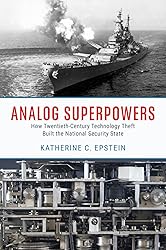
Analog Superpowers: How Twentieth-Century Technology Theft Built the National Security State
Format:
Hardcover
Detalles del producto
Disponibilidad:
En stock
En stock
Peso con empaque:
0.67 kg
0.67 kg
Devolución:
Sí
Sí
Condición
Nuevo
Nuevo
Producto de:
Amazon
Amazon
Viaja desde
USA
USA
Sobre este producto
- *Winner of the 2025 Robert H. Ferrell Book Prize *Winner of the 2025 Samuel Eliot Morison Award for Naval Literature A gripping history that spans law, international affairs, and top-secret technology to unmask the tension between intellectual property rights and national security. At the beginning of the twentieth century, two British inventors, Arthur Pollen and Harold Isherwood, became fascinated by a major military question: how to aim the big guns of battleships. These warships — of enormous geopolitical import before the advent of intercontinental missiles or drones — had to shoot in poor light and choppy seas at distant moving targets, conditions that impeded accurate gunfire. Seeing the need to account for a plethora of variables, Pollen and Isherwood built an integrated system for gathering data, calculating predictions, and transmitting the results to the gunners. At the heart of their invention was the most advanced analog computer of the day, a technological breakthrough that anticipated the famous Norden bombsight of World War II, the inertial guidance systems of nuclear missiles, and the networked "smart" systems that dominate combat today. Recognizing the value of Pollen and Isherwood's invention, the British Royal Navy and the United States Navy pirated it, one after the other. When the inventors sued, both the British and US governments invoked secrecy, citing national security concerns. Drawing on a wealth of archival evidence, Analog Superpowers analyzes these and related legal battles over naval technology, exploring how national defense tested the two countries' commitment to individual rights and the free market. Katherine C. Epstein deftly sets out Pollen's and Isherwood's pioneering achievements, the patent questions raised, the geopolitical rivalry between Britain and the United States, and the legal precedents each country developed to control military tools built by private contractors. Epstein's account reveals that long before the US national security state sought to restrict information about atomic energy, it was already embroiled in another contest between innovation and secrecy. The America portrayed in this sweeping and accessible history isn't yet a global hegemon but a rising superpower ready to acquire foreign technology by fair means or foul — much as it accuses China of doing today.
AR$111.374
44% OFF
AR$61.875
IMPORT EASILY
By purchasing this product you can deduct VAT with your RUT number
AR$111.374
44% OFF
AR$61.875
 Llega en 8 a 12 días hábiles
con envío
 Tienes garantía de entrega
Este producto viaja
de USA ![]() a tus manos en
a tus manos en
![]()
 a tus manos en

Compra protegida
Disfruta de una experiencia de compra segura y confiable
Tarjetas de Crédito y Débito

Visa

Mastercard

American Express
Pagos a través de PayPal
Compra procesada en dólares con dinero en cuenta o tarjetas internacionales.

Paypal
Pagos a través de MODO
Compra procesada en pesos desde la App de tu banco.

PayPal