
















SKU/Artículo: AMZ-B0GNH16283
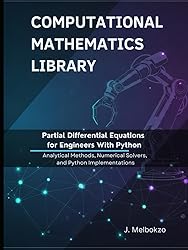
Partial Differential Equations for Engineers With Python: Analytical Methods, Numerical Solvers, and Python Implementations (Computational Mathematics Library)
Format:
Hardcover
Detalles del producto
Disponibilidad:
En stock
En stock
Peso con empaque:
0.97 kg
0.97 kg
Devolución:
Sí
Sí
Condición
Nuevo
Nuevo
Producto de:
Amazon
Amazon
Viaja desde
USA
USA
Sobre este producto
- Master the PDE methods that power real scientific and high consequence engineering analysis, from transport and diffusion to waves, potentials, and coupled multiphysics systems. This practical, rigor minded guide connects governing equation derivations to well posed boundary and initial value problems, then shows you how to solve them with the tools used across advanced research and computational modeling.You will build intuition for elliptic, parabolic, and hyperbolic behavior and learn when separation of variables, eigenfunction expansions, Green’s functions, characteristics, and transform methods are the right approach. Each topic is reinforced with full Python code demos that implement the mathematics step by step, so you can validate solutions, explore parameter sensitivity, and reproduce results in your own workflows.Numerical methods receive equal focus. You will implement stable finite difference time marching for diffusion and waves, construct upwind schemes for transport and shock like behavior, and formulate finite element solutions from weak forms and variational principles. The result is a unified toolkit for verifying analytical solutions, prototyping solvers, and building confidence in simulations where correctness, stability, and boundary conditions matter.Designed for readers who want both depth and usability, this book emphasizes energy methods, maximum principles, eigenvalue problems, modal analysis, and multidimensional coordinate systems, then extends these ideas to coupled field models such as reaction diffusion, thermoelasticity, and incompressible flow. If you need PDE competence that translates directly into modeling, computation, and publishable work, this is the reference you will keep open.Key features:Clear links between conservation laws, constitutive models, and PDE formWell posedness, uniqueness, and stability treated as engineering requirementsTransform, eigenfunction, and Green’s function methods with worked examplesFinite difference, finite volume style upwinding, and finite element formulationsFull Python code demos in every chapter for verification and experimentation
AR$466.570
31% OFF
AR$321.768
IMPORT EASILY
By purchasing this product you can deduct VAT with your RUT number
AR$466.570
31% OFF
AR$321.768
 Llega en 8 a 12 días hábiles
con envío
 Tienes garantía de entrega
Este producto viaja
de USA ![]() a tus manos en
a tus manos en
![]()
 a tus manos en

Compra protegida
Disfruta de una experiencia de compra segura y confiable
Tarjetas de Crédito y Débito

Visa

Mastercard

American Express
Pagos a través de PayPal
Compra procesada en dólares con dinero en cuenta o tarjetas internacionales.

Paypal
Pagos a través de MODO
Compra procesada en pesos desde la App de tu banco.

PayPal